Method
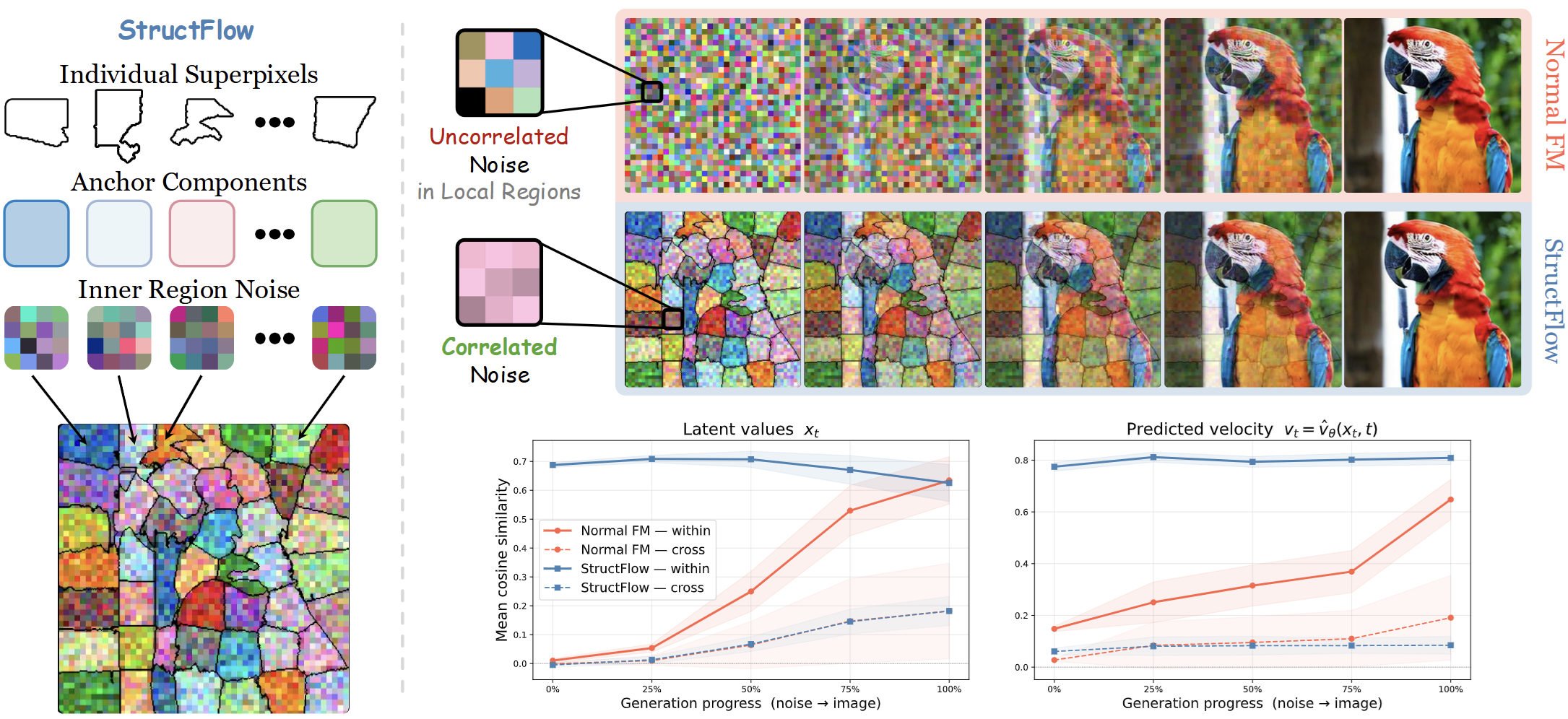
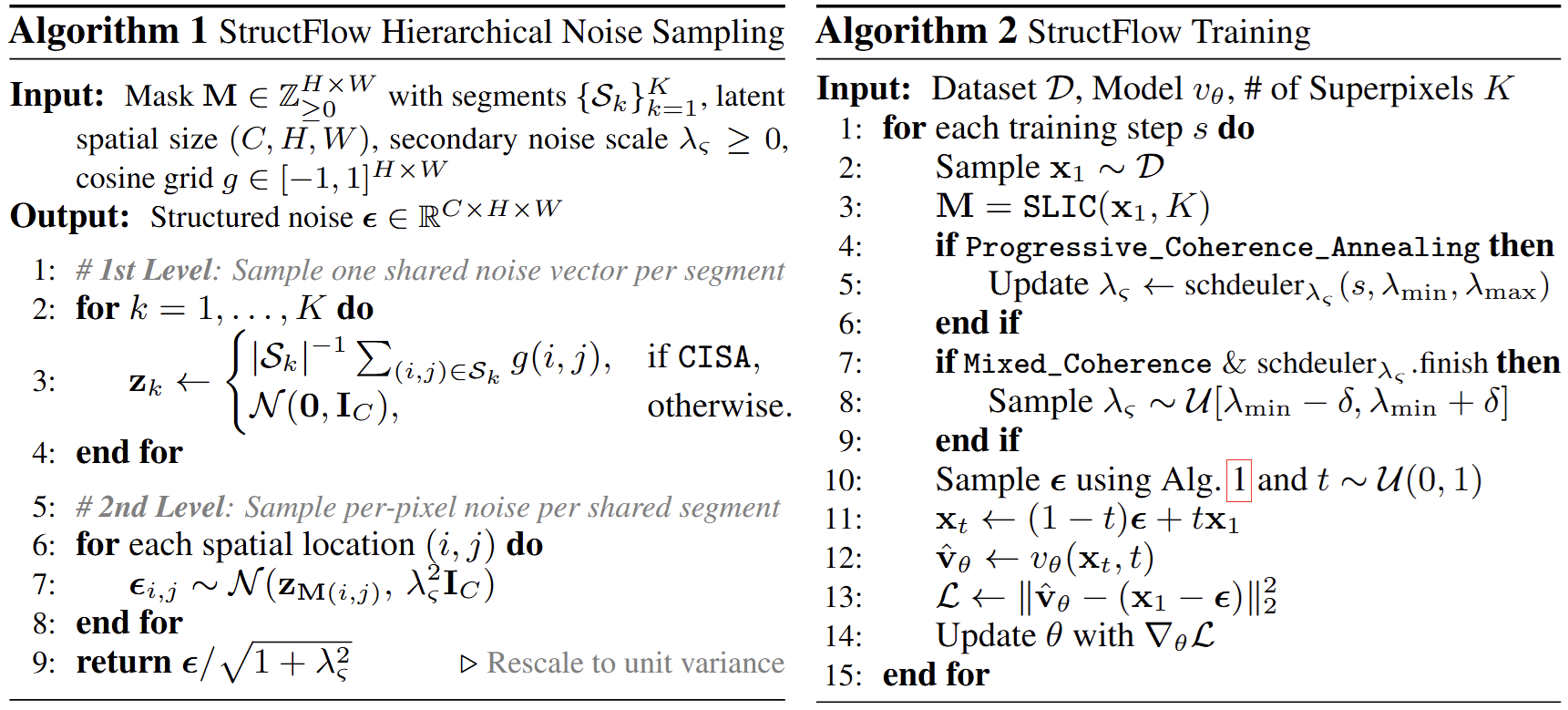
Standard flow matching samples its source noise i.i.d. per pixel, ignoring the fact that nearby pixels in natural images are strongly correlated — forcing the model to reconstruct this local structure entirely on its own. StructFlow instead tries to enforce this locality into the initial noise distribution. During training, each image is first partitioned into local regions using SLIC superpixels; every region is assigned a shared "anchor" noise vector, and each pixel then samples its own noise around its region's anchor, so nearby pixels are correlated while different regions stay independent. No other part of the flow matching objective or inference procedure is modified. Because strongly correlated noise can destabilize training, we introduce three techniques to make it practical: cosine-induced spatial anchoring, which replaces random per-segment anchors with a smooth, deterministic cosine field to reduce stochastic variance; progressive coherence annealing, which starts training near a standard Gaussian source and gradually tightens the locality constraint — this also lets a pretrained flow matching model be turned into a StructFlow model via lightweight fine-tuning; and mixed-coherence training, which varies the coherence strength during training so a single model spans the full quality-editability trade-off at inference. Algorithms 1 and 2 below summarize the noise sampling and training procedure.
Results
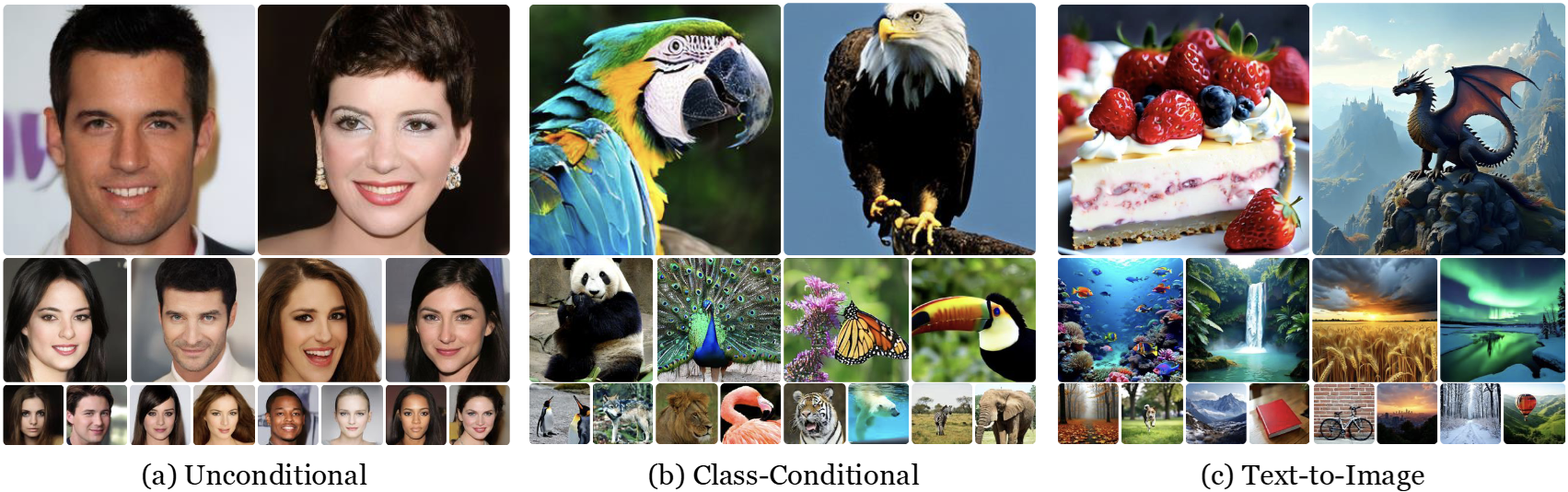
Qualitative Results on Different DiT Models. StructFlow produces high-quality and diverse samples across unconditional, class-conditional, and text-to-image generation settings, on both a DiT-XL model trained from scratch and a SANA model post-trained with StructFlow.
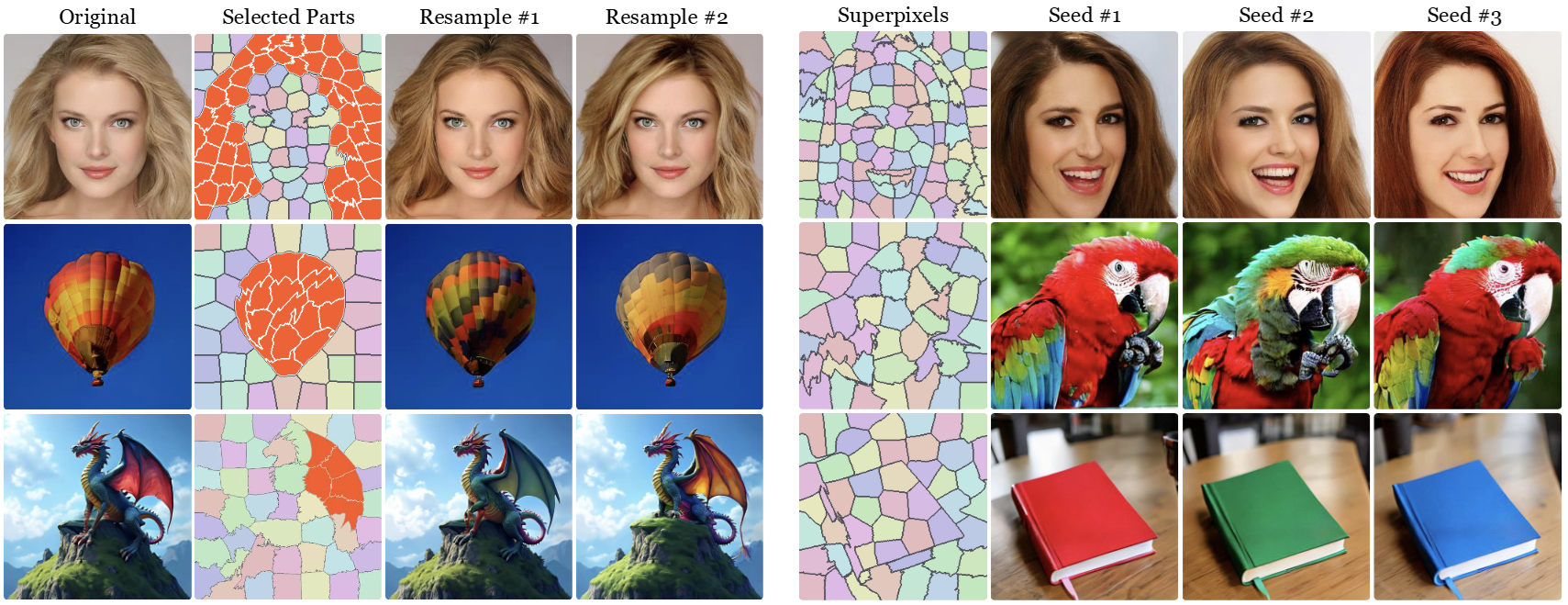
Structure Preservance Generation and Part Resampling. StructFlow enables fine-grained local edits by resampling noise only in selected regions while keeping the rest fixed (left), and generates diverse samples that preserve the overall structure when conditioned on the same superpixel mask (right).