Arman Zarei

I am a third-year Computer Science Ph.D. student at the University of Maryland, advised by Soheil Feizi.

My research focuses on Image Generative Models and Vision-Language Models, with a particular interest in understanding and interpreting how these models function. I am especially interested in enhancing compositional abilities, accelerating inference, localizing and editing knowledge, unlearning undesirable information, and improving image editing capabilities in text-to-image generative models.

In the past, my research has spanned various domains, including Deep Learning Robustness, 3D Vision, and the application of Machine Learning to address neuroscientific challenges, such as improving the performance of seizure detection devices.

Email / Google Scholar / Linkedin / Github / CV

AgentComp: From Agentic Reasoning to Compositional Mastery in Text-to-Image Models

Arman Zarei, Jiacheng Pan, Matthew Gwilliam, Soheil Feizi, Zhenheng Yang

Under Review

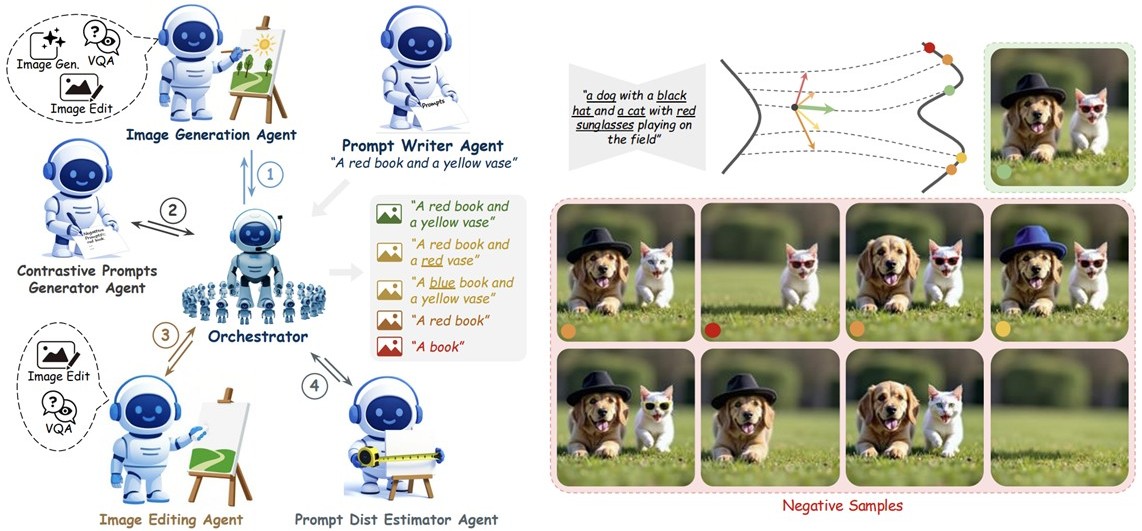
Our paper introduces AgentComp, an agentic orchestration framework that autonomously builds compositional training data and trains text-to-image models to better distinguish compositionally similar prompts and images, resulting in stronger and more reliable compositional generation without sacrificing image quality.

Improving Compositional Attribute Binding in Text-to-Image Generative Models via Enhanced Text Embeddings

Arman Zarei*, Keivan Rezai*, Samyadeep Basu, Mehrdad Saberi, Mazda Moayeri, Priyatham Kattakinda, Soheil Feizi

Preprint

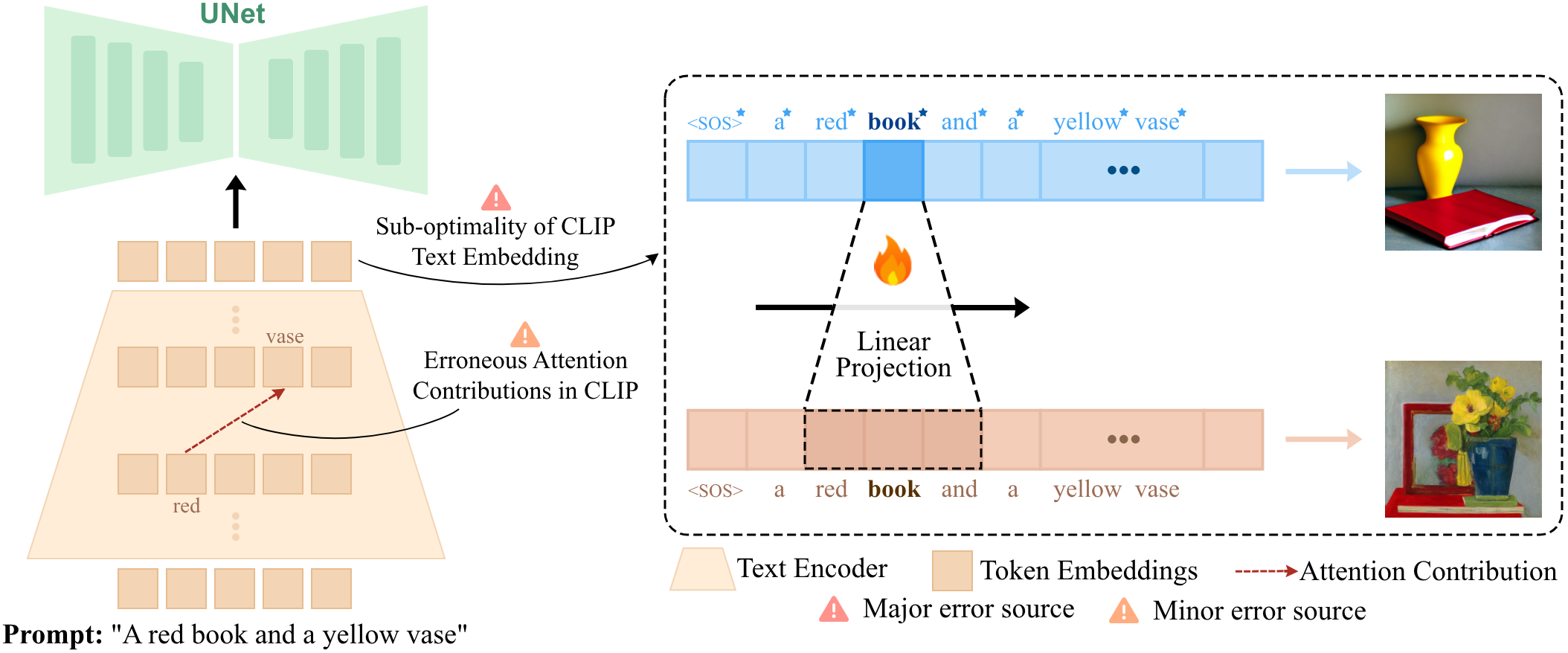
Our paper demonstrates that text-to-image generative models often fail at accurately composing attributes and relationships due to sub-optimal text conditioning by the CLIP text-encoder, and we show that significant compositional improvements can be achieved by fine-tuning a simple linear projection on CLIP's representation space.

A Data-Centric Approach for Improving Adversarial Training Through the Lens of Out-of-Distribution Detection

Mohammad Azizmalayeri*, Arman Zarei*, Alireza Isavand, Mohammad Taghi Manzuri, Mohammad Hossein Rohban

CSICC, 2023 (Oral Presentation)

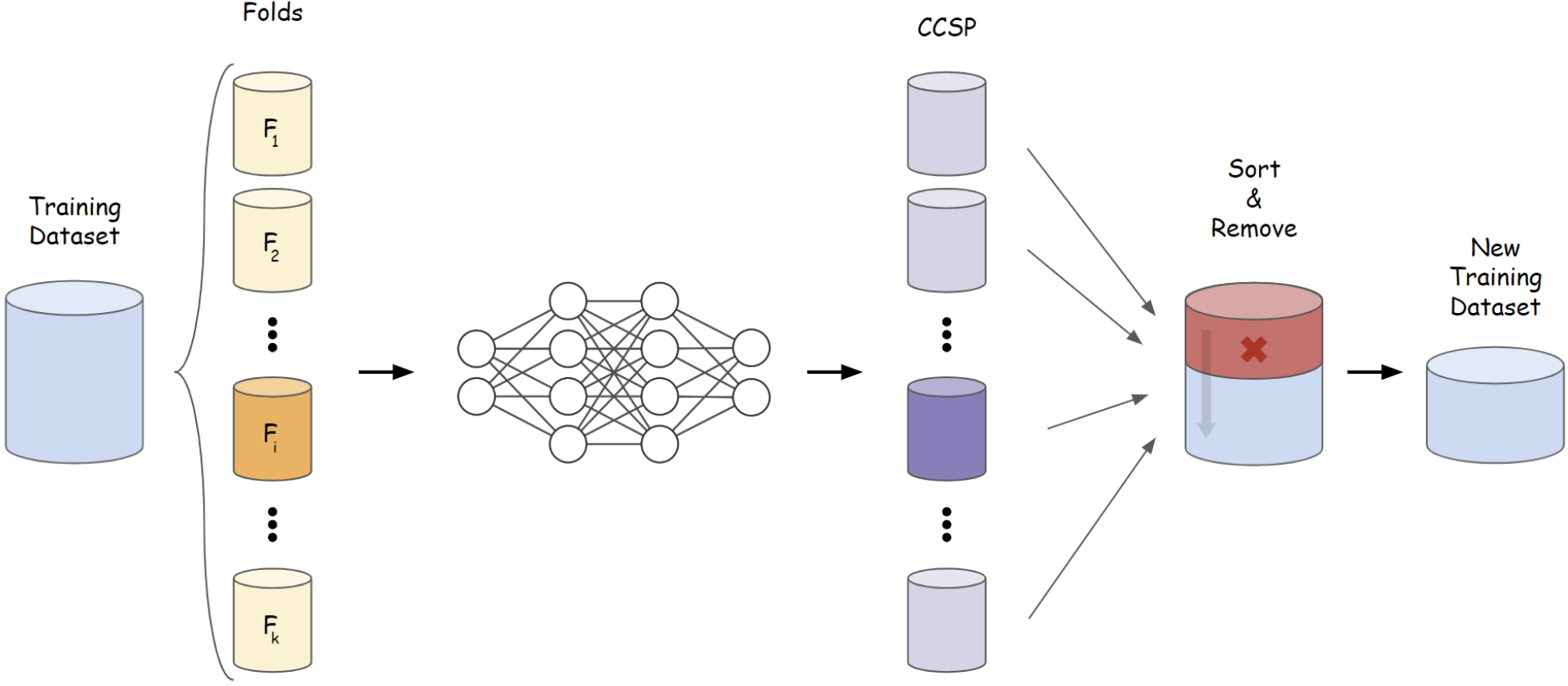
This research offers a data-centric approach to enhance machine learning model robustness against imperceptible adversarial perturbations by detecting and removing challenging samples during training, resulting in improved adversarial training.

PhytoOracle: Scalable, modular phenomics data processing pipelines

Emmanuel M. Gonzalez, Ariyan Zarei, Nathanial Hendler, Travis Simmons, Arman Zarei, Jeffrey Demieville, Robert Strand, Bruno Rozzi, Sebastian Calleja, Holly Ellingson, Michele Cosi, Sean Davey, Dean O. Lavelle, Maria Jose“ Truco, Tyson L. Swetnam, Nirav Merchant, Richard W. Michelmore, Eric Lyons, Duke Pauli

Frontiers in Plant Science, 2023

PhytoOracle (PO) introduces modular, scalable pipelines for processing large volumes of phenomics data, improving efficiency, enabling data fusion, and supporting multi-system trait extraction, with broad applicability across species and various data sources, including drone data.